
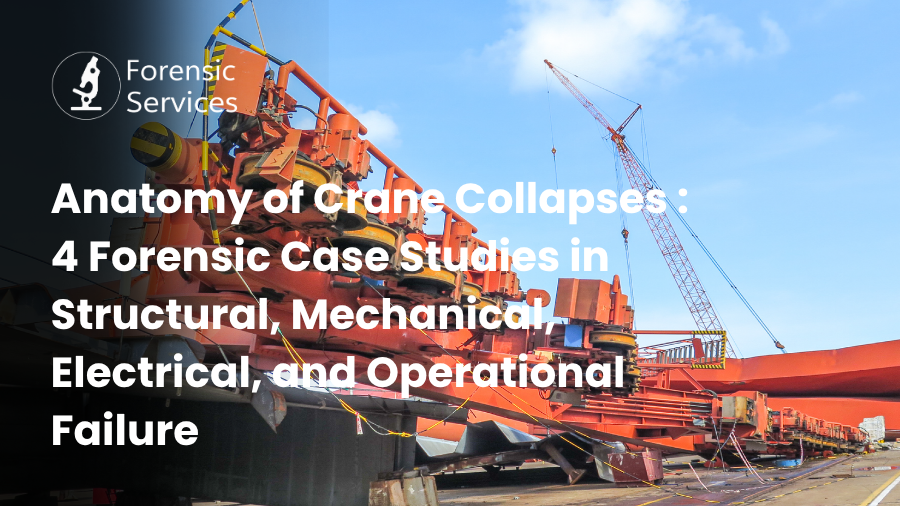
Anatomy of Crane Collapses: 4 Forensic Case Studies in Structural, Mechanical, Electrical, and Operational Failure
Technical Article | Forensic Engineering Insights & Site Safety Mitigation
Executive Summary
Crane collapses on construction sites are frequently attributed to simple overloading, yet forensic engineering reveals that catastrophic failures often stem from subtler, overlooked root causes. Analysing four distinct forensic reports demonstrates how structural impact damage, mechanical gear degradation, electrical control malfunctions, and inadvertent operator movements trigger collapses across crawler, derrick, and tower cranes.
Case 1: Structural Failure – Pre-Existing Impact Damage (Crawler Crane)
While engaged in pile-driving operations that involved repeatedly lifting and dropping a heavy weight, a lattice-boom crane suffered a sudden boom collapse that fell forward with a distinct displacement to the left. Forensic examination revealed that the primary failure mechanism was a buckled front left chord exhibiting a classic three-point bend. FSM investigators evaluated simple overloading as a potential cause but ruled it out because an overload would have dropped the boom straight forward rather than at a severe lateral angle. Inspection of a fractured lacing showed no evidence of metal fatigue; however, a 300 mm scrape mark across the buckled chord proved that pre-existing wall thickness reduction from a prior physical impact had compromised the structural member prior to the incident.
This case underscores the crucial risk of operating lattice-boom equipment with undetected impact damage, emphasising the necessity of mandatory non-destructive inspections to identify localised scraping or wall thinning before high-vibration pile-driving operations.
Case 2: Mechanical Failure – Gear Degradation and Cumulative Wear (Crawler Crane)
A crawler crane was lifting a concrete casing at an active construction site when its lattice boom failed structurally and landed atop a nearby telescopic boom. Physical examination of the dismantled components revealed severe wear across the gear train teeth, including a fatigue tooth fracture. Investigators evaluated the gear assembly and determined that excessive tooth wear prevented proper gear meshing, concentrating disproportionate operational loads onto individual teeth until slipping occurred during lifting operations. Furthermore, visual inspection of the dismantled boom showed widespread deformation across multiple chords and lattices rather than a single localised impact zone, indicating that structural damage had accumulated over multiple unrecorded prior incidents.
To mitigate future risks, asset managers must implement strict periodic gear-mesh tolerance inspections and immediately repair minor lattice deformations before cumulative structural wear triggers catastrophic slipping under load.
Case 3: Electrical Failure – Control System Short-Circuit (Derrick Crane)
At a dam construction site, a derrick crane boom collapsed unexpectedly into the site during a lunch break, just ten minutes after its remote control switch was turned off. A thorough physical investigation revealed that all steel cables, sheaves, winch components, and structural I-beams remained completely intact, eliminating mechanical overload, component fatigue, or deliberate sabotage as potential failure causes. FSM engineers evaluated the electrical setup and discovered that while the remote control unit was powered off, the main electrical power supply to the winch motor remained fully energised. An electrical short circuit within the contactor assembly initiated the winch motor, causing it to spontaneously unwind and release the suspended boom.
This failure highlights a critical site safety risk, establishing that site protocols must enforce complete main electrical power breaker isolation during operational breaks alongside regular contactor box maintenance.
Case 4: Operational Failure – Side Loading and Whiplash Dynamics (Luffing Tower Crane)
While manoeuvring a bar-cutting machine 1 metre above ground at a construction site, a luffing tower crane suffered a severe jib collapse, buckling between sections 1 and 2 and landing to the right of the mast. FSM forensic engineers systematically evaluated multiple potential causes, including structural overloading, connecting pin detachment, and electrical slewing motor failure, ruling them out due to intact connecting pins, split pins, working limit switches, and the lateral resting position of the collapsed jib. The investigation concluded that the root cause was operator error: while turning to investigate an unusual motor sound from behind, the operator accidentally engaged the control stick, causing the crane to slew to the right. The low-hanging load caught on an obstacle, pulling the hoisting cable taut until the load suddenly freed itself, causing an extreme lateral whiplash force that buckled the luffing jib.
This incident stresses the need for strict clearance checks around low-hanging loads, routine verification of safety-stick locks, and operator training on unintended control actuation.
Key Takeaways for Site Operations
- Pre-Operation Inspections: Always inspect lattice chords and main members for localised scrape marks or wall thinning caused by prior transit or site impacts.
- Mechanical Maintenance: Monitor gear tooth wear tolerances to prevent load concentration and fatigue fractures.
- Power Isolation: Never rely solely on remote switches during breaks; lock out main breakers to prevent unintended motor actuation from electrical short circuits.
- Control Discipline: Ensure slewing paths are clear of obstacles during low-height manoeuvres to prevent destructive lateral whiplash dynamics.
Consulting Engineers and Resident Metallurgist of Forensic Services Malaysia investigated numerous failures involving collapse of various types of cranes.
Grounded in scientific method, our forensic investigation and root cause analysis are holistically carried out. The in-depth analysis is reinforced by ISO 17025 accredited metallurgical laboratory.
Contact us to discuss how an independent engineering failure investigation can assist in claims management, litigation support, and/or risk assessment.
Disclaimer
This article is provided solely for general knowledge sharing and educational purposes. It does not constitute legal, engineering, or safety advice. The authors and publisher accept no liability for any loss, damage, or consequences arising from reliance on this article. Readers must refer directly to original authoritative documents, applicable legislation, standards, and qualified professionals when assessing risks or implementing safety measures.
Need clarity on a large and complex incident?
Our forensic consultants are ready to investigate, analyse and support you – from claims to courtrooms.