
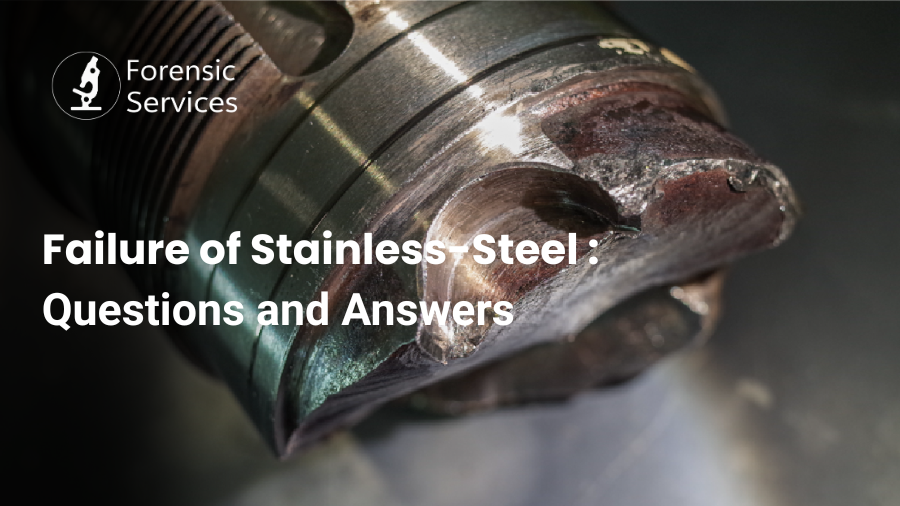
Failure of Stainless-Steel : Questions and Answers
There are much questions about metallurgical analysis involving failures of steel posted by our clients to us during our last webinar entitled “Hidden Cracks, Sudden Failure: How a Stainless-Steel Fitting Failed Despite its Corrosion Resistance”. We are gathering those questions and answered them in the article below.
 If SEM confirms the presence of stress corrosion cracking, how can we determine whether the root cause was the stainless-steel material itself, the chloride-containing environment, or the operating conditions?
Answer: If the stainless-steel material itself is suspected as the contributing factor, our investigation can assess this through chemical analysis and laboratory testing. SEM-EDX can also be used to detect the significant presence of chloride, if any, on the examined surface.
Answer: Assessment of the operating conditions would be subject to the available background information and the consultant’s professional discretion.
Would there be any visible sign from a Stainless-Steel failure?
Answer: There are several damage mechanisms that may be associated with stainless-steel failure, such as stress corrosion cracking (SCC), embrittlement, and fracture.
Generally, NDT methods such as dye penetrant testing (DPT) can be used to highlight the presence of surface-level macro cracks.
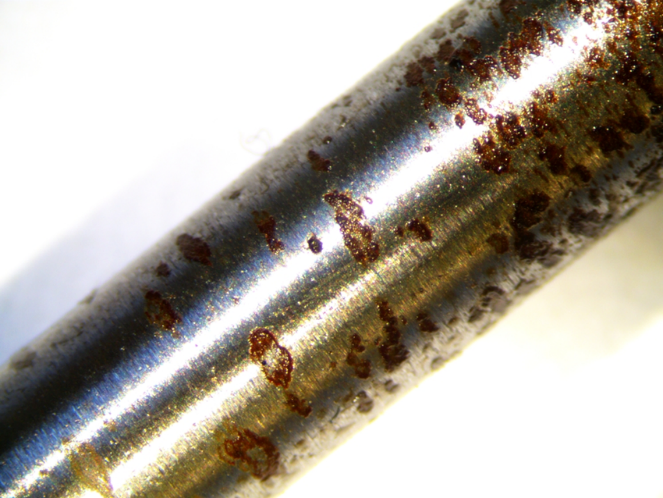
How can marine transportation conditions, including humidity, salt-laden air, and condensation, lead to rust or oxidation on steel coils shipped from China and Vietnam to Indonesia, and what should inspectors look for upon receipt?
Answer: Assuming that the steel coils are made from stainless steel, pitting corrosion is one of the features that are generally observed on stainless steel. Inspectors should look for signs of pitting or localized corrosion on the coil surfaces upon receipt. The attached image provides an example of pitting corrosion.
Apart from chloride being one of the triggers, what other chemicals or situations would cause reaction on the stainless steel first layer to begin rusting?
Answer: A damage mechanism known as flue dew point corrosion is an example.
It is generally triggered by sulphur- and chlorine-containing species, such as sulphur dioxide (SO₂), sulphur trioxide (SO₃), and hydrogen chloride (HCl). It can affect 300-series stainless steel and carbon steel in fired-process equipment where fuels containing sulphur are burned, such as boilers and heaters. The occurrence of this damage mechanism depends on factors such as the concentration of contaminants and the operating temperature.
Apart from marine & agricultural environment, what other industry field/environment that this case commonly occurred?
Answer: SCC in stainless steel can occur in various industries, including oil and gas, petrochemical, chemical processing, power generation, water treatment, desalination, pulp and paper, and food processing involving salt. Its occurrence depends on the environment, temperature, stainless-steel grade, and applied stress.
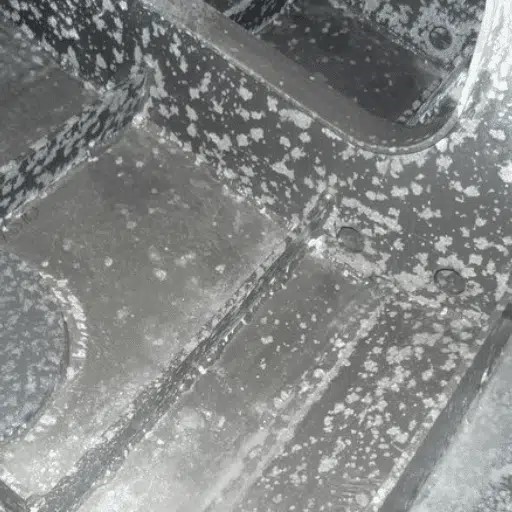
About aluminium corrosion, can aluminium corrode by contact with water moisture in air?
Answer: Yes. Aluminium can corrode when exposed to moisture in the air. This can appear as a white powdery deposit, commonly referred to as “white rust” or white corrosion products. (see photo for example).
If the steel coils had involved in a fire, does it anyway affect the quality and integrity of the coils?
Answer: Yes, fire exposure can affect the quality and integrity of steel coils, depending on temperature and exposure. As a general rule of thumb, changes in metal properties can start to occur at temperatures as low 200°C. We call it as temper temperature.
The extent of the damage can be assessed through visual examination, dimensional checks, and material testing where necessary.
Metallurgist of Forensic Services Malaysia investigated numerous failures involving stainless-steel, mild steel, copper, bronze, and other materials such as furnace bricks.
Grounded in scientific method, our forensic investigation and root cause analysis are holistically carried out. The in-depth analysis is reinforced by ISO 17025 accredited metallurgical laboratory.
Contact us to discuss how an independent failure analysis can assist in claims management, litigation support, and/or risk assessment.
Disclaimer
This article is provided solely for general knowledge sharing and educational purposes. It does not constitute legal, engineering, or safety advice. The authors and publisher accept no liability for any loss, damage, or consequences arising from reliance on this article. Readers must refer directly to original authoritative documents, applicable legislation, standards, and qualified professionals when assessing risks or implementing safety measures.